
Made possible by a grant from the Bellevue College Foundation.
Rus Higley answers student questions in a video at https://www.youtube.com/@nklane2322
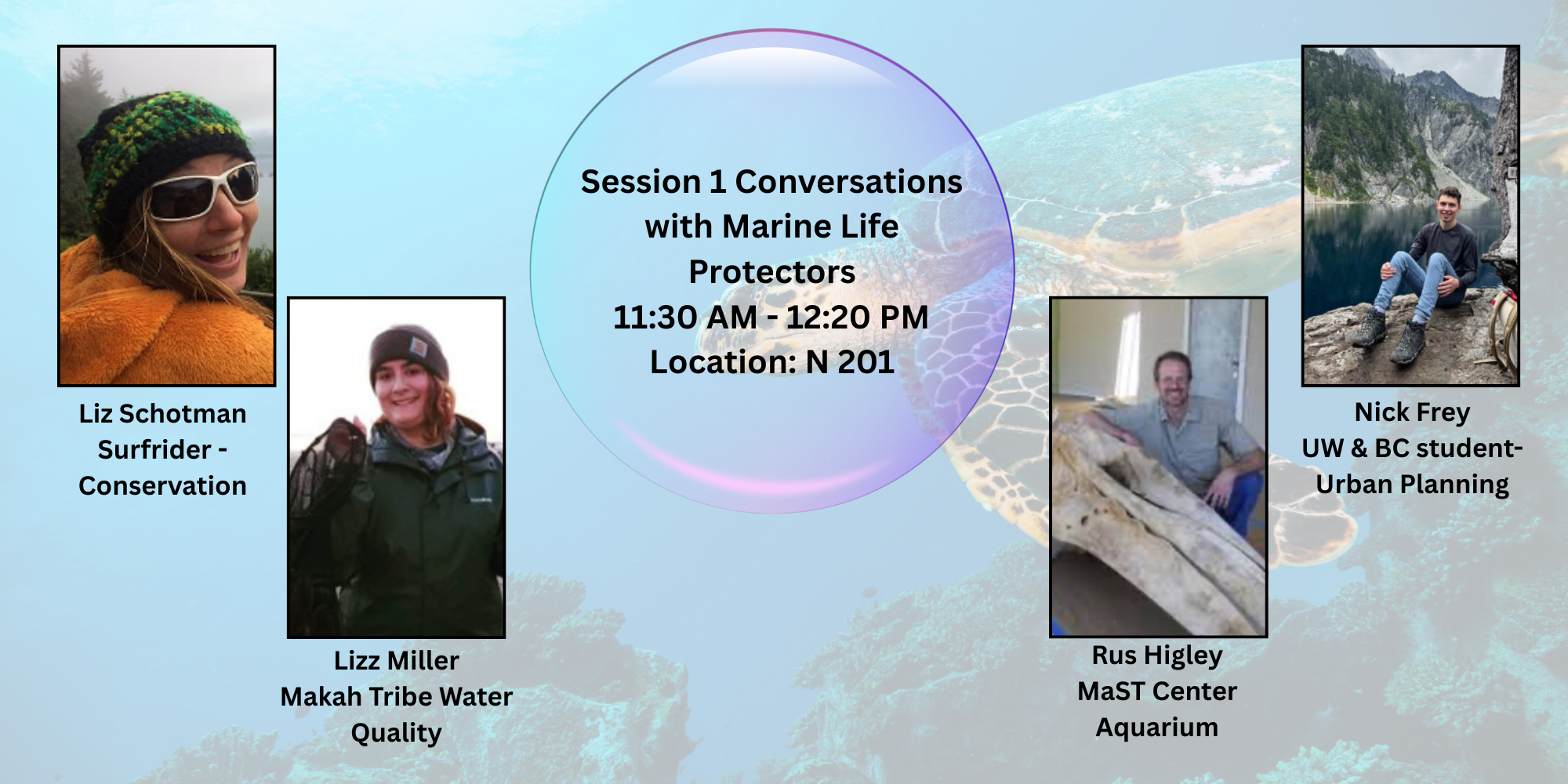
Long Description of the Image: The image serves as an announcement for a session titled “Conversations with Marine Life Protectors.” It features four framed photographs of people, each labeled with their name and role, positioned around a central bubble-like shape contains the following event details Session 1 Conversations with marine life protectors, 11:30 AM – 12:20 PM, Location N 201. The background consists of a gradient of blue shades resembling water, with a faint image of a sea turtle visible on the right side. The top-left photo Liz Schotman wearing sunglasses and a colorful beanie against a backdrop of trees and a description that says surfrider – conservation. The bottom-left is of Lizz Miller holding a net, dressed in outdoor gear and a description that says Makah Tribe Water Quality. The top-right is of Nick Frey sitting on a rock in a mountainous landscape by a lake and a description that says UW & BC Urban planning. The bottom-right photo shows Rus Higley seated next to a skeletal structure of a marine animal and a description that says MaST Center Aquarium.
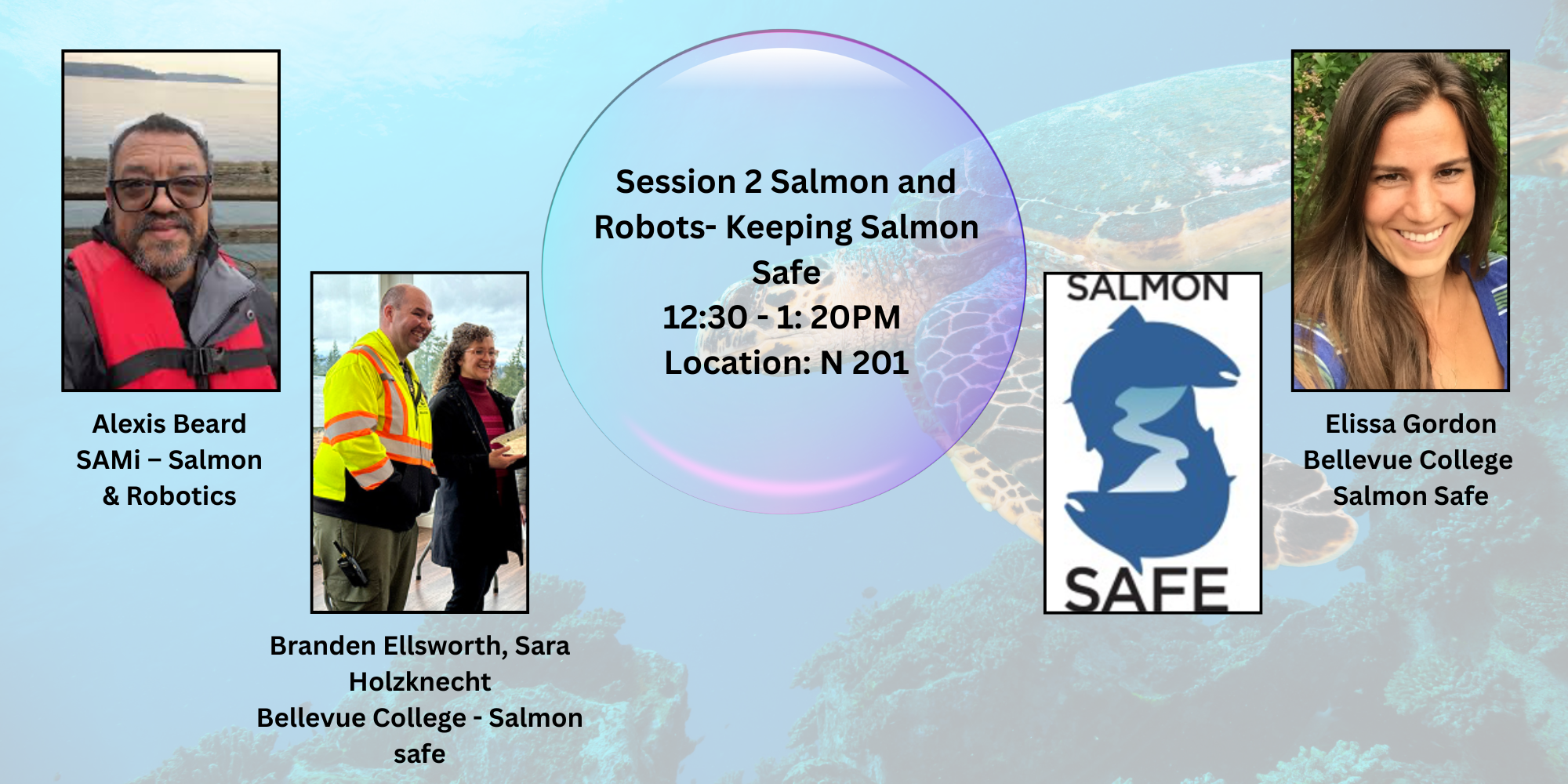
Long Description for the image: The image serves as an announcement for a session titled “Session 2 Salmon and Robots – Keeping Salmon Safe.” It features three individual photographs with names and affiliations below each image. On the left, Alexis Beard is shown wearing a life jacket with water in the background, associated with “SAMi – Salmon & Robotics.” In the center, a photograph displays Branden Ellsworth and Sara Holzknecht standing together, with Branden wearing a high-visibility jacket. Their text reads “Bellevue College – Salmon safe.” On the right, Elissa Gordon is pictured smiling, associated with “Bellevue College Salmon Safe.” The background features a subtle underwater scene with a blurred turtle. In the middle, there is a circular overlay containing the following event details Session 2 Salmon and Robots- Keeping Salmon Safe 12:30 – 1:20PM Location: N 201 and a “Salmon Safe” logo featuring stylized fish silhouettes.
Please post your questions for the speakers here. Make sure you give the name of the speaker so your question will be directed to the right person! Thank you, Prof Nancy
Liz Schotman
Given your extensive experience in marine conservation, what do you believe are the most effective strategies for engaging local communities in protecting coastal ecosystems?
Hi, This question is directed to Lizz Miller. How long do you think it is until we start to see permentant, or at least long term, damage to ecosystems due to algal bloom? we are already seeing the harm being done to things such as shellfish harvesting, do you think this could breach those sectors and start effecting other lifeforms in the region?
This question is for Lizz Miller.
What specific impacts should we as humans anticipate on the shellfish populations that are important to the Makkah Tribe? What adaptive strategies are going to be the most effective in mitigating the effects?
Hi there, this question is for Nick Frey.
What motivates you to promote sustainability? Such as what classes you had to take, and how people can follow your steps and learn more about the environment?
What were some of the adversaries that you had to face in order to reach out to others on maintaining sustainability at Bellevue College?
Which environmental issues is most important for students at Bellevue College to address to today, and how would we measure the success of the initiative that can be proposed to deal with this issue?
Hi this question if for Nick Frey. What do you think is the biggest environmental issue right now and whats a small change you think makes the biggest difference at a community level?
Lizz Miller questions:
Cooper Coombs: This question is directed towards Lizz Miller, given your experience with pollution and improving water quality, what sources of pollution are the most long lasting and damaging to the water quality and aquatic life, and what level of irreversibility has already been reached for the effect this pollution has caused?
Emily Vargas: I was wondering if you could describe your role within the Makah Tribe’s Water Quality Program, and what the key objectives are that the program is currently pursuing? I was also wondering what the most significant water quality challenges facing the Makah Tribe are, and how the Water Quality Program is working to address them? Lastly, looking ahead, what initiatives or projects are you most excited about that will enhance water quality monitoring and protection within the Makah Tribe?
Jane Mun: What was it about working with Makah Tribe’s water quality program that drew you to pursue this career, and how does your work tie into Makah culture and traditions?
Hello, Alexis Beard these questions are for you
1. Reflecting on your 25 plus years of experience, what’s one major shift you’ve observed in STEM education that you believe has had the greatest impact on student engagement?
2. Given your experience in robotics, what do you think is the role of robotics and how does it work with keeping salmon safe?
3. What first inspired you to pursue a career in STEM education, and how has your motivation evolved over time?
4. All of the years of your education how much of it, did it translate with your career? From, Mahilan Selvakumar, Sunny Tam, Jackson Kokich, Nathan Sanchez
Rinny, Michelle, Hadia, Zaynab, Kalia, Gisele
To Liz Schotman
1. What encouraged your love for animals?
2. When was your shark attack? What caused it? Where did it happen?
3. What made you want to move to Washington?
4. Would you say you live sustainably?
5. What things do you do, or avoid doing, in your daily life to maintain sustainability?
Questions for Rus Higley
1. What is the hardest part about helping students turn their love for the ocean into real science work?
2. The artificial reef project sounds fascinating! What was the biggest problem you faced while doing it, and how did you solve it?
3. If you could do any project you want, with no limits on time or money, what would it be?
4. What’s the most important message you want students like us to remember about the ocean and the environment?
5. What has been the most memorable moment in your career that reminded you why you do this work?
6. Have you ever faced resistance when trying to introduce new environmental initiatives, and how did you build support for them?
Leon Vadchochai , Jessie Chang
A question for Lizz Miller,
How does the harmful algal blooms affect the marine life in the water and are there solutions to prevent the harmful algae to blooms? If not, is there anything being done to minimize the blooms?
These questions are for Lizz Miller, Hi!
1. Harmful algae blooms are becoming increasingly more prevalent, and I know a little bit about agriculture’s harmful effects on water quality. What are ways you know of that farms (big or small) can help mitigate their damage?
2. How cooperative has the state of Washington been while working with the Makah Tribe? What ways (that you have experienced in your work) is the reservation system of land beneficial and harmful to ecosystem and cultural conservation?
3. Lastly, how common were HABs before human-caused climate change and pollution? Were they still part of the healthy lifecycles of an ecosystem? Can HABs only form in still water or very small bodies of water?
Hi, I have a question for Alexis Beard
When you plan to release the salmon in June, what will that process look like and what specific steps or considerations are involved for the salmons transition? I’m also interested in understanding how the release is managed and what factors are taken into account to support their survival and adaptations.
Hi there, this question is for Liz Schotman.
In your role overseeing the Surfers Foundation’s chapters along the Washington coast, how do you balance grassroots community cleanup efforts with raising public awareness and achieving effective results? What strategies have you found most effective in translating the enthusiasm of community volunteers into sustained policy momentum?
Hi, this question is for Alexis Beard. As a video student, what piece of equipment that you work with gets you the clearest image of beneath water’s surface? What is the most helpful piece of equipment that you work with?
Liz Schotman
1. What’s the most impactful simple change that everyone could make do to make a difference?
My question is for Liz Schotman.
What are the biggest current barriers (policy, financial, or political) to making successful nature-based solutions (like the driftwood fence) the required approach for shoreline management in Washington, replacing traditional hard engineering and concrete coastal defenses?
Hi, this question is directed to Liz Schotman. You’ve spent a lot of time working in marine conservation, so I’d love to hear your thoughts on what really works when it comes to getting local communities involved in protecting coastal ecosystems. What kinds of approaches or programs have you seen make the biggest difference in helping people feel connected to these environments and motivated to take care of them?
Hi, this is a question for Lizz Miller. How might new technologies help tribal water programs balance traditional ecological knowledge with modern scientific monitoring?
Hi, this is a question for Rus Higley. I was wondering what ultimately led you down this career path and what do you think a person in high school should start doing if they wanted to find a path in this field?
Hello, question for Rus Higley !
I was reading about your artificial reef project and it sounds interesting ! What was one of the hardest difficulties you faced while doing it, and how did you solve it?
Hello, question for Liz Schotman. I read about your work with the Surfrider Foundation and the role you have played in helping local communities protect the coast. My question now is, what are some of the most significant challenges you faced while trying to make these kinds of programs successful?
Hi, this is a question for Lizz Miller!
How did the Makah tribe initially discover the HABS, and in what ways do the HABS have negative impacts on the marine life and people who consume them? Since the water samples from the Pacific Ocean can help predict the algae blooms, scientists are able to determine the expected intensity of them and when that will happen, but is there going to be anything to reduce demonic acid production before it reaches that point?
Hi this is a question for Nick Frey, I had been looking at your Salmon recovery project and was wondering what the process what like when you had implemented compost BURritos? I also was wondering how the group decided where they wanted to install them?
Hello! This question is for Rus Higley! I read an article with you in it about the sixgill shark, and how it is a sighting seen in Des Moines, and I wanted to know what was special about the Puget Sound that makes them want to hang out around here, and not other places. Is it a lower population of humans? I also wanted to know what you thought about the effects of ocean acidification on the sharks as that is something I am learning about in class.
Hi, this question is for Liz Schotman. You’ve worked to improve our oceans water quality and to protect our Washington coast. What worked best for you when trying to get younger people and communities to take action against pollution and marine debris?
Hello, this question is for Liz Schotman. I’ve read about your work with the Surfrider Foundation and how you focus on reducing plastic pollution. If there was one law or community change you think would make the biggest difference for ocean health in the next few years, what would it be and how could students like us help support it?
Hi, this is a question for Nick Frey,
Since your main thing is talking about sustainability, what are some small everyday things people do everyday that hurt our environment that no body really notices until it all starts to stack up? Also what is something little everyone can do just to help our environment get 1 percent better each day?
Hi, this question is for Lizz Miller. I was wondering how do the Makah tribe and the other tribes in the ORHAB partnership share data and coordinate their monitoring efforts?
Hi Liz! I read that you work with the Surfrider Foundation to protect ocean water quality and beaches. What inspired you to get involved in ocean conservation, and what’s the most rewarding part of your job when it comes to protecting marine life?
Hi! I have some general questions.
With the emphasis of community and tribal partnerships, I was wondering if any local communities and indigenous knowledge would be able to work effectively together or if there would be any challenges?
The videos also shows relationships between education, community engagement, and conservation. How do you see colleges or local institutions playing a role in environmental activism?
Hello,
I have one question for Rus Higley, because you specialize in helping students get started in marine science, I wanted to know what advice would you give to students who do not know where to begin in helping protect marine life. Specifically if they live farther from an ocean.
My question is more of a broader one to Nick Frey. What do you think is the biggest environmental issue right now in our current day to day lives.
Hi, there are some questions for Rus Higley and Elissa Gordin.
In your restoration efforts, you discussed balancing the removal of invasive species with maintaining biodiversity and ecosystem resilience. Can you elaborate on any unforeseen ecological consequences or trade-offs observed after large-scale interventions, and how your team adapts management in response?
Regarding the problem of sixgill shark conservation in Puget Sound, are there emerging research directions or techniques that could offer new insights into their life cycles, migration patterns, or vulnerability factors?
I had a question for Rus Higley. Why do you think the sixgill sharks choose to give birth in the Puget Sound? What makes the Puget Sound an optimal place for them to give birth rather than someplace else? Is it the water conditions, better breeding grounds, the depth, access to resources?
I didn’t have any specific questions, but the video “Voices of Action Protectors of Marine Life” brought up some reflective points. The speakers in this video were genuinely inspiring because of the honest and practical advice they shared. Nick Frey’s message really stood out to me, he emphasized that it’s okay to pursue financial stability, as long as you never lose sight of your inner compass and the goals that give your life meaning. Liz Schotman added an important reminder that it’s normal for our desires, values, and priorities to evolve over time, as we grow the things we want and need naturally change, and it’s okay to adjust our path accordingly. Rus Higley also offered valuable insight by explaining how breaking big goals into smaller, manageable steps can make long-term success feel much more achievable.
I have a couple of questions for Sara, Elissa, and Branden because I’m really impressed with the sustainability work happening at Bellevue College, especially the focus on trees and native plants. I found all the planted areas amazing, and I appreciated the detailed information signs provided about each plant.
1) Is there a place where I can learn about volunteer opportunities, such as joining the team to remove invasive species or help plant native plants?
2) Can the compost-burrito approach be used in the planting strip between the sidewalk and the road?
These questions are directed towards Liz Schotman but an answer from anyone is appreciated.
1.)When studying deep-water sharks like the six gill, what has been the biggest challenge collecting accurate data on their movements or behavior, and how do you work around those challenges.
2.) During the Whale Building 10, what inspired you to start the working with whale skeletons, and what part of that rebuilding process do you find the most meaningful or rewarding?
3.)Six gill sharks are rarely seen by the public. What is one thing you wish more people understood about their ecological role or importance in the marine ecosystem?
Hi this is questions for Alexis Beard :
-We shouldn’t be scared of AI because it’s already here. How have you already used AI to make your lessons better?
-How can students actively look for teachers if their schools don’t make it easy for them to do so?
Hello,
I have a question for Rus Highley, What part of the whale project was actually the hardest for you. Getting the whale, composing the bones, or putting the skeleton together?. I think its a very interesting project.
I also had a question for Elissa Gordon about the salmon and 6PPD quinone. Since 6PPD comes from tires, are there any safer alternatives being researched so this toxin doesn’t keep forming? and what signs or symptoms do salmon show when they have being affected? This question kind of goes to us the students but, How can students help with the ongoing salmon project on campus?
Hello,
Thank you to all the speakers for the presentations. I really enjoyed learning about the different ways marine species in the Puget Sound are affected by human activity. The part about TRWP and how 6PPD transforms into 6PPD-quinone was especially shocking to me, especially knowing how toxic it is for salmon, particularly Coho. I also liked seeing the student captured footage of the young Chinook salmon and the quill-fish it made the issues feel much more real and immediate. So my question is directly For Alexis Beard: The video showing the young Chinook salmon was fascinating. In your experience, what signs show that younger students truly understand the importance of protecting these marine habitats?
I learned a little about whale bones, sixgill sharks, and how students recorded young Chinook salmon and a quillfish. The part about TRWP from car tires turning into 6PPD-quinone was surprising because it can hurt Coho salmon near Bellevue College. It made me think about how small things can affect the whole environment. I have some questions for speakers:
For Whale Building Speaker:
What do we learn about whales from their skeletons?
For Sixgill Shark Speaker:
How do you study sixgill sharks when they live so deep?
For Alexis Beard:
How do you record salmon without disturbing them?
For Salmon Safe Team:
Is there a safer tire chemical than 6PPD?
For Salmon Safe Team (BC):
What is the next step to protect salmon near our campus?
Hello! I found Rus whale project very fascinating and was wondering if there was anything you would do different to plan out the entire process?
Hello, I have a question for Sara Holzknecht, Elissa Gordon, and Branden Ellswort. What specific actions is Bellevue College taking to reduce pollution in local waterways? And why are salmon so sensitive to water quality and toxins?
Question for Liz Schotman, I understand that the field of marine protection is constantly evolving. What changes in Marine conservation work have you personally seen over the past years?
Hi,
I have some questions for Sara Holzknecht, the discussion mentioned salmon numbers are in crisis in the Pacific Northwest, what are some of the highest contributing factors? How do compost-BURritos work, and are there other filtration types that can be used? So far is data showing less PPD-quinone entering waterways as a result of these filtration methods?
Thank you!
The Voices of Action videos helped me better understand both the diversity of marine life and the environmental challenges affecting local species. I especially enjoyed seeing the “Whale Building 101” segment and learning about sixgill sharks, as well as the student-captured footage of young Chinook salmon and the rarely seen quillfish. The most concerning part was the scanning electron microscopic image of TRWPs and the explanation of how 6PPD-quinone forms from tire wear particles and poses a serious threat to Coho salmon, especially in streams near Bellevue College. Overall, the videos made me more aware of how everyday human activities directly impact aquatic ecosystems and the importance of continuing salmon-safe practices.
For Elissa Gordon,
What additional steps can students personally take to help reduce TRWP and other pollutants from entering local waterways?
Questions I had.
1)How would you explain marine science concepts to someone who doesn’t have any science background, how would you start off those conversations without confusing someone or without making them lose interest.
2)What was a specific instance where you were able to say that the communities education made a difference in helping people understand these concepts?
3)What new tools or techniques are you excited to see help the study of deep water animals in the future? This question is specifically about like technology that’s developing nowadays.
hi ,
i have a question for Rus Higley
What inspired you to begin working in marine conservation, and what suggestions would you give to students who want to get involved, especially if they do not live near the coast?
Hello, these are some questions for Alexis Beard.
What improvements or features would you add to the robots if funding were unlimited?
What kinds of underwater data are the most useful when identifying salmon-safe or salmon-unsafe areas?
Lastly, what are your hopes for how robotics could scale salmon-safe practices beyond just one campus or community?
Hello, I have a question for Alexis Beard.
Which hands-on activities or teaching methods have you found most effective in helping high school students develop empathy for salmon and other marine animals, and why do you think these experiences make such an impact?